LEADER JEFFRIES ON SQUAWK BOX: "WE ARE WORKING HARD TO DECISIVELY CONFRONT THIS REPUBLICAN HEALTHCARE CRISIS"
Today, House Democratic Leader Hakeem Jeffries appeared on CNBC's Squawk Box, where he emphasized that a majority of the House has signed onto the Democratic bill to extend the ACA tax credits, and Mike Johnson must bring it up for a vote immediately.
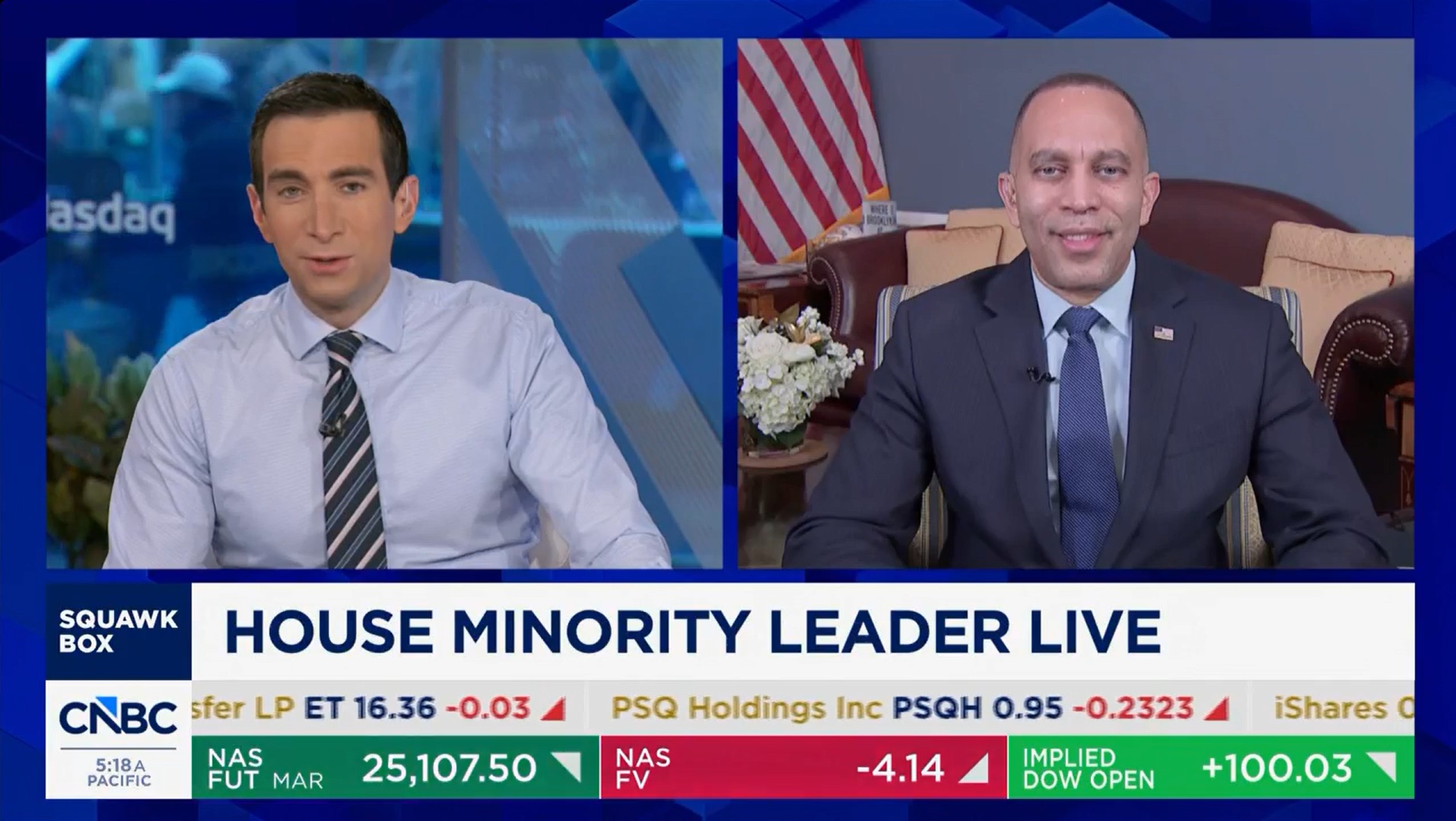
ANDREW ROSS SORKIN: Joining us right now is House Minority Leader Hakeem Jeffries. Good morning to you. You heard the President last night. He says the Democrats are in the pockets of the insurance companies and that the price of your healthcare is actually going to go down under his plan. What say you?
LEADER JEFFRIES: Well, good morning, great to be with you. The Republican healthcare crisis is devastating the American people and Donald Trump has zero credibility on the issue of healthcare. This is the party that has enacted the largest cut to Medicaid in American history in the same bill where they enacted massive tax breaks for their billionaire donors because of Republican policies in the One Big Ugly Bill. We know that hospitals, nursing homes and community-based health centers are closing all across the country, including in rural America. Republicans have launched an all-out assault on the Centers for Disease Control, the National Institute of Health, the Food and Drug Administration, on vaccine availability for children and now Republicans are refusing to extend the Affordable Care Act tax credits, which means that tens of millions of Americans, working-class Americans, are about to experience dramatically increased health insurance premiums. We are working hard to decisively confront this Republican healthcare crisis and fix our broken healthcare system.
ANDREW ROSS SORKIN: Leader, let me ask you this, and I recognize the complications and costs to the American public. There is a question, and maybe you'd say it's a longer-term question that has to be dealt with later, but the true question ultimately underneath all this is how we're going to actually lower the cost of healthcare in America. And when I say lower the cost, not just lower the cost for individuals, meaning in the moment subsidize it, but how we actually change the market dynamic at play and whether what you have proposed even tries to address that at all or frankly exacerbates it.
LEADER JEFFRIES: What we've proposed at the moment relates to the fact that the Affordable Care Act tax credits are going to expire on December 31 and no one disputes that, if that happens, tens of millions of Americans are going to experience skyrocketing health insurance premiums, in some cases increasing by $1,000 or $2,000 per month. And 90% of the people who rely on the Affordable Care Act tax credits make around $63,000 per year. These are working-class Americans, everyday Americans and middle-class Americans. And so, we've got to make sure that we don't allow these tax credits to expire. At the same time, you raise a very good point, Andrew, that the healthcare system is broken and we need to fix it. We want to fix it in a comprehensive way, in a bipartisan way. But that actually requires Republicans deciding to abandon their my-way-or-the-highway approach to everything, which is what has led to the extremism that they're jamming down the throats of the American people and the fact that everyday Americans, voters, are rejecting that extremism as we saw in the off-year elections last November.
MICHAEL SANTOLI: Leader Jeffries, you mentioned that the vast majority of those who use the supplemental subsidies for the ACA are well below the wealthy thresholds that the Republicans are talking about, which is four times the poverty line. Is that in play in terms of a negotiated agreement here? They keep talking about that as maybe a sticking point. How does your party feel about simply having an income cap for these subsidies?
LEADER JEFFRIES: We have a bipartisan coalition right now that supports, in the House of Representatives—that's every single House Democrat and at least four House Republicans—supports a straightforward extension of the Affordable Care Act tax credits. Time has run out. Republicans have had all year to deal with this issue and have chosen not to do it because they were focused on passing their One Big Ugly Bill, which they enacted with great urgency months ago. The largest cut to Medicaid in American history, the largest cut to nutritional assistance in American history. They literally ripped $186 billion away from SNAP. That's food from hungry children, hungry veterans and hungry seniors. And why did they do all of that? So they can enact massive tax breaks that they made permanent for their billionaire donors, and skyrocketed the debt by over $3 trillion, and now at the 11th hour, time has run out, and we've got the votes to pass a straightforward extension and send it over to the Senate. Mike Johnson needs to make sure we vote on this legislation today. The House should not recess or adjourn until this issue has been dealt with.
MICHAEL SANTOLI: What is your expectation? You say you have the votes. You've mentioned the four Republicans that have come on over to join you, and then the Senate seems like it's kind of a no-go no matter what. So, I mean, what are we looking at come next week?
LEADER JEFFRIES: Well, what's interesting about the Senate is that there are a majority of U.S. Senators, Democrats and Republicans, who've already supported, in the vote that took place a few weeks ago, a straightforward extension of the Affordable Care Act tax credits. And so once we send the bill from the House over to the Senate, then the Senate can negotiate a path forward that enables them, hopefully, to break the filibuster and get something done for the American people. We can work on this issue in a bipartisan way, as has now been demonstrated in the House of Representatives. We do need some presidential leadership. Part of the issue is that Donald Trump still seems to believe that the affordability crisis is a hoax. In fact, he said that repeatedly. Costs haven't gone down in this country. Costs have gone up, despite the fact that Donald Trump did promise his words, not mine, that costs would go down on day one. Housing costs out of control, grocery costs out of control, electricity bills out of control, healthcare costs out of control. Action needs to be taken in all of these areas. We're prepared to work with our colleagues on the other side of the aisle. We just need good faith and Republican leadership.
ANDREW ROSS SORKIN: Talk about costs getting out of control. You mentioned healthcare. Interestingly, you look at employment in America over the past year, and actually, it is the healthcare industry where so much of the employment has come from. What do you make of that?
LEADER JEFFRIES: Well, listen, I think we've got to take a look at the economy as a whole and all of the individual sectors. In this country fundamentally here's our belief: you work hard, you play by the rules you should be able to live an affordable life, a comfortable life, live the good life. And to me that's a good-paying job, good housing, good healthcare, good education and a good retirement, which means the extremists need to keep their hands off Social Security and Medicare. That should not be too much to ask for in this great country of ours, the wealthiest country in the history of the world. So, you know, listen, we support the notion that economic growth that moves in a positive direction is good for everyone. But we've got to make sure that this fundamental principle, hard work paying off, playing by the rules paying off and the American dream being brought to life, is actually realized and revived because far too many people understandably have concluded, I'm talking about working-class folks, middle-class folks, that the American dream is out of reach as we approach our 250th birthday. That's a shame.
ANDREW ROSS SORKIN: Leader Jeffries, I have maybe a curveball of a question, but we just talked to Jamieson Greer, and it's something that I think is on the mind of a lot of folks who are watching this broadcast now as it relates to tariffs, a lot folks waiting to find out what the Supreme Court has to say about the tariffs that have been implemented by the President. I believe you have come out strongly against those tariffs. There's a real question, though, about whether, if they were struck down, whether the court could force, effectively, the U.S. Government to give back the $200 billion that has been collected in tariffs and how that could rescramble the economy. And I'm curious what the sort of Democratic position would be on something like that.
LEADER JEFFRIES: Well, the implications of the Supreme Court striking down those tariffs, I think, have to be evaluated. Our view, as you indicated, Andrew, from the very beginning, is that the President has violated his authority. He doesn't have the emergency authority to implement this random, massive tariff scheme that's imposing thousands of dollars of additional cost on everyday Americans, which is why the American people reject these tariffs. I think that if the Supreme Court strikes down these tariffs, then Congress should come together in a bipartisan way and figure out the path forward, anchored in the reality is what's best for the American people? What's best for our companies and our corporations? What's best for the economy to ensure that we can continue to see American exceptionalism prevail?
ANDREW ROSS SORKIN: Leader Jeffries, we want to thank you for joining us this morning. We want to wish you happy holidays if we don't see you before the break next week. Thank you.
LEADER JEFFRIES: Happy holidays, thank you.
ANDREW ROSS SORKIN: You bet.
Full interview can be watched here.